horse health

-
Equine elders
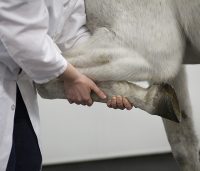
Every year, veterinarians at the Western College of Veterinary Medicine’s Veterinary Medical Centre (VMC) examine and treat hundreds of horses from across Western Canada. While some equine patients may recover and never need to return to the teaching hospital, others may become “regulars” with the WCVM clinical team. “Blue” and “Fire” were two patients that fit the latter category. These …
May 30th, 2018 Full story »

-
Surgical solution for PPID?
A Canadian researcher is working to develop a surgical technique that could, one day, provide a long-lasting fix for pituitary pars intermedia dysfunction (PPID) in horses. PPID, also historically known as Cushing’s disease, occurs when a part of the pituitary gland called the pars intermedia becomes enlarged and secretes excessive levels of adrenocorticotrophic hormone. The body reacts to this excess …
May 25th, 2018 Full story »

-
Horse Health Lines (Spring 2018) online
The Spring 2018 issue of Horse Health Lines, news publication for the WCVM’s Townsend Equine Health Research Fund, is now online. You can also view the publication as part of the May/June issue of Canadian Horse Journal or check out the PDF version. Inside this issue, you’ll find the following stories: Surgical solution for PPID?: A WCVM researcher is working on a surgical option for treating pituitary pars intermedia …
May 25th, 2018 Full story »
-
Researchers use human medicine to further equine research
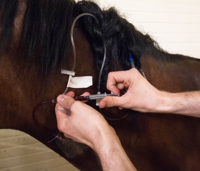
While unexpected results can lead to headaches and frustration for everyone involved, they proved to be a bonus for a team of researchers from the Western College of Veterinary Medicine (WCVM). Dr. Julia Montgomery and her research team encountered surprising results while conducting a study aimed at finding biomarkers for equine metabolic syndrome (EMS), a metabolic and hormonal disorder in …
March 13th, 2018 Full story »
-
High-tech horse adds value to WCVM
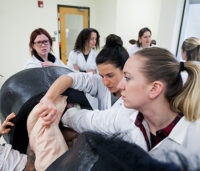
A group of first-year veterinary students gather around a life-sized black plastic horse, holding up what looks like a large piece of intestine. “Wow! Cool!” exclaim several students as Dr. Julia Montgomery demonstrates the digestive system inside the equine model. This isn’t just any horse. It’s an advanced equine simulator, made possible by a $50,000 donation from the Equine Foundation …
February 06th, 2018 Full story »

-
The vet behind the PowerFloat
Ask any horse owner or equine veterinarian about the PowerFloat, and they’ll tell you that the rotary dental instrument is synonymous with equine dental care — an essential tool that’s well known in the horse community. The PowerFloat was the brainchild of Dr. Dennis Rach, a Calgary-based large animal veterinarian who has always liked solving problems. Rach has been practising …
February 06th, 2018 Full story »

-
Reining in equine obesity
Imagine you’re a draft horse. The year is 1927 and you spend most of your time hooked up to a plow in the field, burning calories and muscle. You dine primarily on grain. It’s important to keep your energy up because you work hard every day and your family depends on you. When the tractor comes along, your role on …
October 23rd, 2017 Full story »

-
Equine sarcoids: a mystery gone viral
Not all detectives wear fancy hats and trench coats with a magnifying glass tucked in the pocket. Some of them wear white lab coats and use powerful microscopes. “My dad’s a pathologist, so there you go. It’s the family business,” says Dr. Bruce Wobeser, associate professor of veterinary pathology at the Western College of Veterinary Medicine (WCVM). “What’s appealing to …
October 01st, 2017 Full story »

-
Horse Health Lines (Spring 2017) online
The Spring 2017 issue of Horse Health Lines, news publication for the WCVM’s Townsend Equine Health Research Fund, is now online. Check out the PDF version of Horse Health Lines. Inside this issue, you’ll find the following stories: • A life saving gift: A $200,000 gift from Saskatoon’s Murray and Shirley Popplewell is helping to establish the Rae-Dawn Arabians Equine Intensive Care …
April 14th, 2017 Full story »

-
Early detection of EMS has big benefits
Weight-related health problems are a growing concern in the world of equine medicine just as they are in the world of human medicine. Excess weight can lead to serious health complications such as the development of insulin resistance – a condition linked to type 2 diabetes in people and equine metabolic syndrome (EMS) in horses. Unfortunately, owners often don’t consider …
March 03rd, 2017 Full story »