horse health

-
Study sets standard for equine lung research
Val Sanford has seen firsthand the negative effects of respiratory problems on horses’ performance in the show ring and on the trail. Sanford, owner and manager of Copper T Warmblood Stables near Saskatoon, Sask., has a horse that suffers from “heaves” or recurrent airway obstruction (RAO). The horse requires individualized management from feeding to exercise: it must be treated before …
March 21st, 2014 Full story »

-
Tying-up syndrome
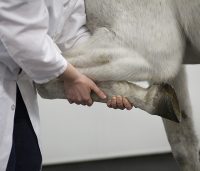
Tying-up syndrome, or rhabdomyolysis, is a myopathy (disorder affecting the body’s muscle system) that causes muscle-cell destruction and decreases an affected horse’s performance. Common systems include painful muscle cramping and hardening as well as severe increases in muscle enzymes that can be detected through laboratory testing. Exertional rhabdoyolyses are disorders that typically occur in horses performing exercise beyond their conditioning …
February 28th, 2014 Full story »

-
Red Deer hosts equine education event
As an equine-minded veterinary student at the Western College of Veterinary Medicine (WCVM), I couldn’t think of a better way to spend my first weekend back to class than at the Alberta Horse Breeders and Owners Conference on Jan. 10-12 — Canada’s premier horse industry event. The annual conference, which celebrated its 32nd year in Red Deer, Alta., is hosted …
February 02nd, 2014 Full story »

-
Protein may help diagnose septic arthritis
Last summer, I was involved in researching a protein called serum amyloid A (SAA) that may help veterinarians reach a proper and early diagnosis of joint infection — a severe and potential life-threatening illness in horses. Infected joints (septic arthritis) is a particular problem in Saskatchewan, mainly because of the widespread use of barbed wire that’s often the culprit behind puncture …
January 20th, 2014 Full story »

-
Equine expo a welcome mid-winter break
Western Canada’s equine community is looking forward to the third annual Saskatchewan Equine Expo at Prairieland Park in Saskatoon from Feb. 14-16, 2014. “We have a full schedule once again this year,” says Brenda Sapergia, livestock manager for Prairieland Park Ag Centre. “Our headline events – the Trainer’s Challenge and the Cowhorse Competition – will of course be returning. New …
January 13th, 2014 Full story »
-
WCVM scientists focus on moon blindness
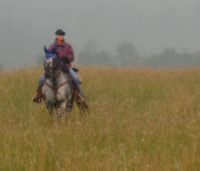
Six years ago, Shelley and Ray Ruiters purchased an Appaloosa mare named Annie from friends who thought she would be a great fit for the couple. It turned out that the Ruiters’ friends were exactly right. “From the first day I met her we just rode off on our own and she never missed a beat,” says Shelley. About a …
December 07th, 2013 Full story »
-
Sable Island ponies “shop” like we do
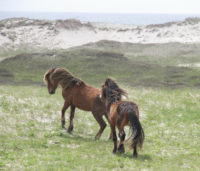
It turns out that horses and people have a lot in common when it comes to shopping habits, according to Philip McLoughlin, associate professor of biology at the University of Saskatchewan. In a paper in the Journal of Animal Ecology, McLoughlin and his colleagues describe the habits of the famous wild horses at Sable Island National Park Reserve off the …
September 24th, 2013 Full story »

-
“SIP project” targets sand colic
I’ve spent a lot of time this summer with my arm up the south end of a lot of northbound horses — all for the sake of finding sand in poop. Nicknamed the “SIP project,” I’m working with Dr. Steve Manning of the Western College of Veterinary Medicine (WCVM) to take repeat fecal samples from a number of horses at equine …
September 20th, 2013 Full story »

-
EHRF Research Grants, 2013-14
Is fine needle aspiration an option for diagnosing equine skin disease? Drs. Bruce Wobeser and Hilary Burgess Skin disease, including both skin cancers and inflammatory conditions, is common in horses. Fine needle aspiration (FNA) is a technique commonly used to diagnose similar conditions in companion animals. It involves inserting a needle into the skin and extracting cells for microscopic observation. …
September 19th, 2013 Full story »
-
Devereux, a horse with heart
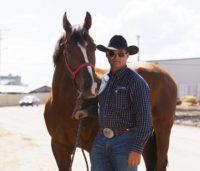
Rick Fraser, along with his daughter Kaylee, made the long road trip from Wetaskiwin, Alta., to Kentucky in the fall of 2012 to purchase new recruits for the family’s award-winning chuckwagon string. They had filled their six-horse trailer and were on their second day of travelling home when they stopped in Saskatoon to rest and check on the horses. That’s …
August 30th, 2013 Full story »