Western College of Veterinary Medicine

-
Early detection of EMS has big benefits
Weight-related health problems are a growing concern in the world of equine medicine just as they are in the world of human medicine. Excess weight can lead to serious health complications such as the development of insulin resistance – a condition linked to type 2 diabetes in people and equine metabolic syndrome (EMS) in horses. Unfortunately, owners often don’t consider …
March 03rd, 2017 Full story »

-
Drugs in my tack box
Much like human sport competitions, irresponsible medication use and a positive drug test can cause serious problems for both the horse and rider at equine events. “If you’re competing in a horse sport, the first thing you need to know is whose rules you’re running under,” says Dr. Trisha Dowling, a board-certified specialist in veterinary pharmacology and large animal internal …
February 12th, 2017 Full story »

-
Planning key to protecting horse’s health
As a horse owner, you’re always on the lookout for potential risks to your horse’s well being at home and on the road. But what you may not realize is that the greatest threat could be standing right in the next stall. “The most dangerous thing to your horse’s health is another horse,” says Dr. Chris Clark, a large animal …
February 11th, 2017 Full story »

-
Vet students help Equine Expo gallop along
When it comes to the equine care available at the Western College of Veterinary Medicine (WCVM), clinicians have access to many advanced technologies and tools that allow them to provide cutting edge care. While those who work with them daily are familiar with them, many horse owners don’t get a chance to see these tools in action unless their animal …
January 27th, 2017 Full story »
-
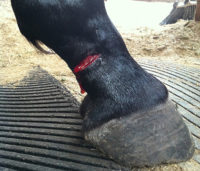
Location key issue in assessing wounds
Horses can suffer from all types of wounds, and while some wounds look much worse than others, the primary assessment of their severity is the same as that of gauging housing prices: location, location, location. This claim is backed by Dr. Suzanne Mund, a master’s degree student in the Western College of Veterinary Medicine’s Department of Large Animal Clinical Sciences. …
January 12th, 2017 Full story »

-
Horse Health Lines (Fall 2016) now online
The Fall 2016 issue of Horse Health Lines, news publication for the WCVM’s Townsend Equine Health Research Fund, is now online. Check out the digital edition of Horse Health Lines or view the PDF version. Inside this issue, you’ll find the following stories: • Dumonts double research dollars: Pat and Mark DuMont commit another $3000,000 to WCVM equine research. • Making …
January 07th, 2017 Full story »

-
What to do if you suspect colic
Most horse owners have their own personal stories to tell about colic — but chances are that everyone’s tales about the dreaded disease are different. Episodes of colic can range from a mild case of abdominal pain that resolves with pain medications to a life-threatening event that requires emergency surgical treatment. With such a variable condition, it can be difficult for …
December 12th, 2016 Full story »

-
Equine drug study leads to rule change
Results from a Western College of Veterinary Medicine (WCVM) study have led to a nation-wide change in Equine Canada-sanctioned competition rules regulating the use of the drug firocoxib in performance horses. The national equine sport organization’s rule change regarding firocoxib’s use came into effect on Jan. 1, 2016. Firocoxib is a non-steroidal anti-inflammatory drug (NSAID) that’s used to treat musculoskeletal …
April 14th, 2016 Full story »

-
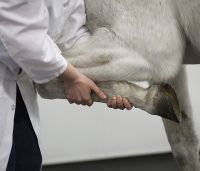
Nerve blocks: working from the bottom up?
As the saying “no hoof, no horse” implies, the diagnosis and resolution of lameness is critical to a horse’s life. Unfortunately, it’s all too common to see a horse limping down the equine ward of the Western College of Veterinary Medicine’s (WCVM) Large Animal Clinic. When there are no obvious external lesions that could explain a horse’s lameness, flexion tests …
April 04th, 2016 Full story »

-
EHV-1 case dies of other health issues
A Saskatoon-area horse that was diagnosed with the neurologic form of equine herpes virus 1 (EHV-1) has been humanely euthanized after developing other health issues. The horse was the first of two local equine patients diagnosed with EHV-1 in the past two weeks. Veterinarians from the Western College of Veterinary Medicine (WCVM) were providing treatment and supportive care for the …
March 31st, 2016 Full story »