equine health

-
Uplifting equine research gains support
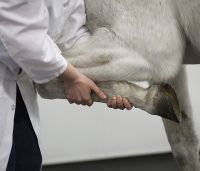
A University of Saskatchewan (USask) research team that’s working with Saskatoon’s RMD Engineering Inc. to create a unique rehabilitation harness for horses has received financial support from Mitacs, a publicly funded not-for-profit research and training organization. “If this works, the potential impact will be huge because there are no long-term rehabilitation harnesses available on the market today,” says Dr. Julia …
April 11th, 2019 Full story »

-
WCVM to pay necropsy fees on WFFS cases
During the 2019 foal season, the Western College of Veterinary Medicine (WCVM) will cover the cost of conducting equine necropsy (post-mortem) examinations on aborted fetuses, stillbirths or euthanized foals that are suspected to be cases of warmblood fragile foal syndrome (WFFS). Canadian horse owners and referring veterinarians can submit cases to Prairie Diagnostic Services (PDS), the provincial veterinary laboratory based …
April 08th, 2019 Full story »
-
Equine foot expert visits WCVM
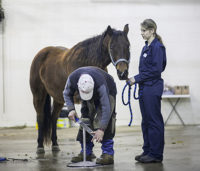
This fall, members of the local horse community and students at the Western College of Veterinary Medicine (WCVM) will have the chance to learn about a novel approach to equine foot health straight from the man who developed the theory. Dr. Robert Bowker, director of the Equine Foot Laboratory at Michigan State University (MSU), and an internationally-acclaimed authority on equine …
March 01st, 2019 Full story »

-
Equine air flow in 3D
A Western College of Veterinary Medicine (WCVM) research team is going back to the drawing board to find a better way of treating recurrent laryngeal neuropathy (RLN), also known as roaring, in horses. Last year surgical specialists Drs. James Carmalt and David Wilson, along with surgical resident Dr. Michelle Tucker, were working on a new procedure that could replace a …
November 01st, 2018 Full story »

-
Job groomed student for vet school
This summer, Chantel Dunlop of Seven Sisters Falls, Man., was standing in a warm-up ring at Calgary’s Spruce Meadows when she read an email message confirming her acceptance into the Western College of Veterinary Medicine (WCVM). “I remember crying out, ’Oh my God!’, and I started to feel shaky,” says Dunlop, who was working as a groom for Olympic medallist …
October 10th, 2018 Full story »
-
Lifesaving support
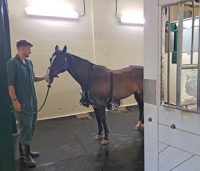
When a person breaks a leg, it’s highly unlikely that this injury would lead to death. But when a horse injures its leg, the all-too-common outcome is euthanasia. The heartbreaking experience of losing an equine companion to a leg injury is a familiar one for Samantha Steinke, a graduate student in biomedical engineering at the University of Saskatchewan. In 2016, …
October 09th, 2018 Full story »
-
‘Lea Riddell, equine vet’
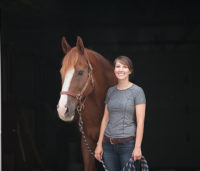
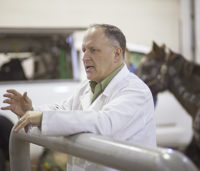
Dr. Lea Riddell has never really fit the mould of an equine veterinarian. A self-proclaimed “city girl,” Riddell was born and raised in Winnipeg, Man. — far from any farm or acreage and with no horses nearby. It wasn’t until she was given a pony riding lesson for her eighth birthday that she discovered her true love for horses. That …
September 26th, 2018 Full story »
-
A life infused with horses
Dr. Steve Manning has enjoyed being around horses since he was a kid riding with the local Pony Club branch in his southern Ontario hometown. That interest prompted him to apply for a summer job with a local equine veterinarian – a move that led to his career choice. “I spent seven summers working in that clinic,” recalls Manning, associate …
August 17th, 2018 Full story »

-
Equine veterinarian’s life comes full circle
For 15 years of her life, Dr. Maia Aspé has ridden horses. Six of those years were spent chasing a career as a professional hunter-jumper before she found her calling in equine veterinary medicine. Those days of competition might be behind Aspé, but the skills, camaraderie and knowledge she picked up along the way continue to enrich her life even …
August 17th, 2018 Full story »

-
TEHRF research grants: 2018-19
The Townsend Equine Health Research Fund (TEHRF) has allocated more than $107,500 to support six equine health research projects at the Western College of Veterinary Medicine (WCVM). WCVM scientists and their collaborators will conduct the research studies over the next 24 months. Read the following summaries for more details about each study. How can computer models improve treatment for roarers? …
June 12th, 2018 Full story »