equine health

-
Fund directs dollars to projects, people
This year, the Western College of Veterinary Medicine’s Townsend Equine Health Research Fund (TEHRF) has targeted just over $100,000 to support three new equine health research projects as well as graduate scholarships and an undergraduate summer research position at the veterinary college. Projects Three equine health research studies, which involve scientists at the WCVM and their collaborators, received a total …
October 08th, 2022 Full story »

-
Horse Health Lines (Fall 2022) now online
The Fall 2022 issue of Horse Health Lines, news publication for the Western College of Veterinary Medicine’s (WCVM) Townsend Equine Health Research Fund, is now online. Click here to view the Horse Health Lines (Fall 2022) issue. You can also download the PDF or view the publication as part of the Fall 2022 issue of Canadian Horse Journal. Here’s a …
October 07th, 2022 Full story »

-
Equine abortions: Chlamydia a culprit?
When veterinarian Dr. Madison Ricard came to the Western College of Veterinary Medicine (WCVM) for her anatomic pathology residency program in 2020, she had no idea that her research would potentially have an impact on the veterinary profession and the horse industry at large. Depending on what she and veterinary pathologist Dr. Bruce Wobeser — her graduate supervisor at the …
October 06th, 2022 Full story »

-
Stem cells as wound healing tool?
A team of researchers at the Western College of Veterinary Medicine (WCVM) has published the first equine study to demonstrate changes in wound healing following stem cell therapy. Their findings were recently published online in Cells, an international open access journal. Team members include PhD student Dr. Suzanne Mund along with WCVM faculty members Drs. Daniel MacPhee, John Campbell, Ali …
March 06th, 2022 Full story »
-
Signal pursuit
Dr. Claire Card has spent much of her career helping mares get pregnant, but for some horses and their owners, it’s complicated. “A lot of horses that are very valuable in terms of their athletic ability or their traits … are not retired from that career until they’re well into their teenage years,” says Dr. Claire Card, an equine theriogenologist …
March 06th, 2022 Full story »

-
Horse Health Lines (Spring 2022) now online
The Spring 2022 issue of Horse Health Lines, news publication for the WCVM’s Townsend Equine Health Research Fund, is now online. You can also download the PDF or view the publication as part of the Spring 2022 issue of Canadian Horse Journal. Here’s a quick look at the stories inside this issue: Unravelling the umbilical cord Does the equine umbilical cord’s …
March 06th, 2022 Full story »

-
WCVM hosts research discussion
Click here to view recording of the Feb. 8 panel discussion on equine health research. Horse health research is the focus of an upcoming virtual panel discussion that’s asking for input from horse owners about current and future research studies at the Western College of Veterinary Medicine (WCVM). The online discussion, which will take place at 7 p.m. CST on …
February 03rd, 2022 Full story »
-
Preventing frostbite in horses
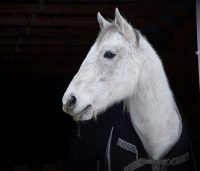
Frostbite isn’t a common medical issue in horses, but under extreme temperatures, a horse’s body decreases the blood supply to its extremities – such as ears, genitals and feet. As a result, fluid in the cells of these body parts forms ice crystals that break or harm cell membranes and cause permanent damage. What environmental conditions are most hazardous for …
January 07th, 2022 Full story »
-
WCVM alumna new AAEP president
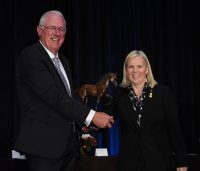
Dr. Emma Read, a 1998 graduate of the Western College of Veterinary Medicine (WCVM), is the new president of the American Association of Equine Practitioners (AAEP) for a one-year term. Read, who is associate dean for professional programs at The Ohio State University College of Veterinary Medicine, was installed as AAEP president on Dec. 7 during the organization’s annual convention …
December 08th, 2021 Full story »

-
Putting laminitis on ice
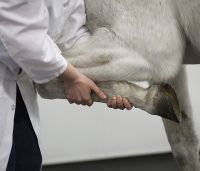
A Western College of Veterinary Medicine (WCVM) research team is gathering information for the development of a new device for cryotherapy (extreme cold therapy) — one of the few treatments available for the painful equine disease known as laminitis. Also described as digital hypothermia, cryotherapy involves submerging an affected horse’s limb and foot in ice and cooling them to four …
December 07th, 2021 Full story »