Research News

-
Equine air flow in 3D
A Western College of Veterinary Medicine (WCVM) research team is going back to the drawing board to find a better way of treating recurrent laryngeal neuropathy (RLN), also known as roaring, in horses. Last year surgical specialists Drs. James Carmalt and David Wilson, along with surgical resident Dr. Michelle Tucker, were working on a new procedure that could replace a …
November 01st, 2018 Full story »

-
Tool harnesses air flow in real time
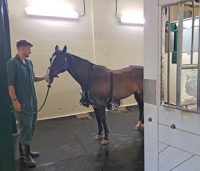
Researchers at the Western College of Veterinary Medicine (WCVM) are collaborating with Andy Adler, a Canada Research Professor in Biomedical Engineering at Carleton University, to use a new technique called electrical impedance tomogrophy (EIT). This non-invasive technology is appealing to veterinary specialists because it will allow them to better understand the changes in breathing patterns happening in sedated and anesthetized …
October 29th, 2018 Full story »
-
Lifesaving support
When a person breaks a leg, it’s highly unlikely that this injury would lead to death. But when a horse injures its leg, the all-too-common outcome is euthanasia. The heartbreaking experience of losing an equine companion to a leg injury is a familiar one for Samantha Steinke, a graduate student in biomedical engineering at the University of Saskatchewan. In 2016, …
October 09th, 2018 Full story »

-
Surgical solution for PPID?
A Canadian researcher is working to develop a surgical technique that could, one day, provide a long-lasting fix for pituitary pars intermedia dysfunction (PPID) in horses. PPID, also historically known as Cushing’s disease, occurs when a part of the pituitary gland called the pars intermedia becomes enlarged and secretes excessive levels of adrenocorticotrophic hormone. The body reacts to this excess …
May 25th, 2018 Full story »
-
Researchers use human medicine to further equine research
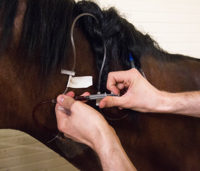
While unexpected results can lead to headaches and frustration for everyone involved, they proved to be a bonus for a team of researchers from the Western College of Veterinary Medicine (WCVM). Dr. Julia Montgomery and her research team encountered surprising results while conducting a study aimed at finding biomarkers for equine metabolic syndrome (EMS), a metabolic and hormonal disorder in …
March 13th, 2018 Full story »

-
Equine sarcoids: a mystery gone viral
Not all detectives wear fancy hats and trench coats with a magnifying glass tucked in the pocket. Some of them wear white lab coats and use powerful microscopes. “My dad’s a pathologist, so there you go. It’s the family business,” says Dr. Bruce Wobeser, associate professor of veterinary pathology at the Western College of Veterinary Medicine (WCVM). “What’s appealing to …
October 01st, 2017 Full story »

-
Discovering the equine small intestine
Until recently, the inside – or lumen— of a live horse’s small intestine was beyond the reach of traditional imaging modalities and remained a mystery to veterinarians. But a group of researchers at the University of Saskatchewan (U of S) have been working on a diagnostic tool that promises to overcome these limitations. In collaboration with Khan Wahid from the …
July 06th, 2017 Full story »

-
Early detection of EMS has big benefits
Weight-related health problems are a growing concern in the world of equine medicine just as they are in the world of human medicine. Excess weight can lead to serious health complications such as the development of insulin resistance – a condition linked to type 2 diabetes in people and equine metabolic syndrome (EMS) in horses. Unfortunately, owners often don’t consider …
March 03rd, 2017 Full story »

-
Drugs in my tack box
Much like human sport competitions, irresponsible medication use and a positive drug test can cause serious problems for both the horse and rider at equine events. “If you’re competing in a horse sport, the first thing you need to know is whose rules you’re running under,” says Dr. Trisha Dowling, a board-certified specialist in veterinary pharmacology and large animal internal …
February 12th, 2017 Full story »

-
Equine drug study leads to rule change
Results from a Western College of Veterinary Medicine (WCVM) study have led to a nation-wide change in Equine Canada-sanctioned competition rules regulating the use of the drug firocoxib in performance horses. The national equine sport organization’s rule change regarding firocoxib’s use came into effect on Jan. 1, 2016. Firocoxib is a non-steroidal anti-inflammatory drug (NSAID) that’s used to treat musculoskeletal …
April 14th, 2016 Full story »