Horse Health

-
WCVM scientists assist in laminitis puzzle
Laminitis research for the layman can be divided into two broad topics: therapies that can be used to treat laminitis and investigations into the chain of signalling events that trigger the condition (new targets for future therapies). Researchers at the Western College of Veterinary Medicine (WCVM) are tackling both aspects. Two of the veterinary college’s scientists — Drs. David Wilson and …
December 18th, 2012 Full story »

-
Laminitis: what does that word mean to you?
Laminitis: what does that word mean to you? Do you think you know all about it, or does hearing the very word have you shaking your head over all we just don’t know. The recent–and some would say long overdue–expansion in laminitis research has spawned a generation of geeks who can speak the lingo and conject about the future. Their …
September 19th, 2012 Full story »

-
Coggins test still vital cog in EIA screening
The standard in equine infectious anemia (EIA) screening is a test known to horse owners everywhere as the Coggins test. A “negative Coggins” is required for import and export of horses and is recommended for any situation in which horses are gathered together, such as a competition or boarding stable. But what exactly is a Coggins test, and how is …
July 12th, 2012 Full story »

-
EIA persistent equine disease in the West
The mention of equine infectious anemia (EIA) or swamp fever holds a special kind of fear for horse owners. With no vaccine and no cure for the disease, a positive diagnosis of EIA is essentially a death sentence as an affected horse must be either euthanized or quarantined for life in fly-proof facilities to avoid infecting other horses. EIA screening …
July 12th, 2012 Full story »

-
Quick tick facts
“Know your enemy” is a well-known military maxim that’s also good advice for people on the Canadian Prairies who are seeing increasing populations of tick species in the region. Here are some quick facts about ticks and tick-borne diseases: Ticks, like spiders and mites, have eight legs in their mature form (as adults) and are members of the class Arachnida. …
May 11th, 2012 Full story »

-
Milagros, the miracle foal
Last spring, Dawn and Dave Roberts were enjoying a Saturday afternoon with friends and family at their farm that’s located minutes west of Saskatoon, Sask. Annie, one of their experienced broodmares, looked like she was going into labour. “Our friends’ kids were excited because they thought they’d be able to see a baby horse being born,” says Dawn, whose family …
April 24th, 2012 Full story »

-
Emergency care for orphan foals: five tips
It’s a position you hope you never need to be in — but if you suddenly become responsible for an orphan foal, here are five tips from Dr. Fernando J. Marqués, a specialist in large animal internal medicine at the WCVM, on what to expect. 1. Consult a veterinarian. “Because foals have no energy reserves in place,” explains Marqués, “they …
April 24th, 2012 Full story »

-
Monensin: fatal feed
This month, a Nebraska-based livestock feed company voluntarily recalled two lots of its “Kountry Buffet” 14 per cent feed because it could contain monensin sodium — a potentially fatal drug for horses. The feed, packaged in 50-pound bags with the Payback logo, was distributed to retailers in Nebraska and Wyoming in December 2011. The company, Western Feed LLC, made the …
March 05th, 2012 Full story »

-
WCVM survey targets Cushing’s disease
Cushing’s disease is considered one of the most commonly diagnosed endocrine disorders of horses — especially as the equine population continues to age. But just how common is the disease internationally? It’s one of the questions that researchers at the University of Saskatchewan’s Western College of Veterinary Medicine (WCVM) are addressing through a 16-question survey of international equine practitioners. “Our objective …
January 26th, 2012 Full story »
-
Marathon surgery saves mare’s life
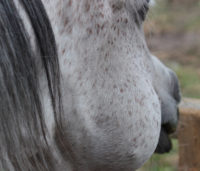
When Dr. James Carmalt examined the grey Arabian mare named Noor for the first time at the WCVM’s Veterinary Medical Centre last fall, the first thing that surprised him about the horse was her body condition. “You could tell that Mr. Abidi (her caregiver) had been working hard to ensure that she had the right type of feed available and …
December 12th, 2011 Full story »