Horse Health

-
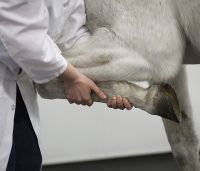
Reining in equine obesity
Imagine you’re a draft horse. The year is 1927 and you spend most of your time hooked up to a plow in the field, burning calories and muscle. You dine primarily on grain. It’s important to keep your energy up because you work hard every day and your family depends on you. When the tractor comes along, your role on …
October 23rd, 2017 Full story »

-
Planning key to protecting horse’s health
As a horse owner, you’re always on the lookout for potential risks to your horse’s well being at home and on the road. But what you may not realize is that the greatest threat could be standing right in the next stall. “The most dangerous thing to your horse’s health is another horse,” says Dr. Chris Clark, a large animal …
February 11th, 2017 Full story »
-
Location key issue in assessing wounds
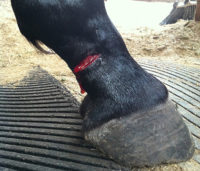
Horses can suffer from all types of wounds, and while some wounds look much worse than others, the primary assessment of their severity is the same as that of gauging housing prices: location, location, location. This claim is backed by Dr. Suzanne Mund, a master’s degree student in the Western College of Veterinary Medicine’s Department of Large Animal Clinical Sciences. …
January 12th, 2017 Full story »

-
What to do if you suspect colic
Most horse owners have their own personal stories to tell about colic — but chances are that everyone’s tales about the dreaded disease are different. Episodes of colic can range from a mild case of abdominal pain that resolves with pain medications to a life-threatening event that requires emergency surgical treatment. With such a variable condition, it can be difficult for …
December 12th, 2016 Full story »

-
Nerve blocks: working from the bottom up?
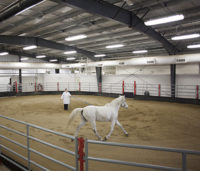
As the saying “no hoof, no horse” implies, the diagnosis and resolution of lameness is critical to a horse’s life. Unfortunately, it’s all too common to see a horse limping down the equine ward of the Western College of Veterinary Medicine’s (WCVM) Large Animal Clinic. When there are no obvious external lesions that could explain a horse’s lameness, flexion tests …
April 04th, 2016 Full story »
-
New tool homes in on equine lameness
Whether their patient is a high performance equine athlete or a beloved pony, veterinarians at the Western College of Veterinary Medicine (WCVM) have access to a full range of technologies that can help diagnose equine lameness and pinpoint problems. A new addition came in August 2015 when the college’s Veterinary Medical Centre acquired a Lameness Locator®, an advanced diagnostic tool …
October 16th, 2015 Full story »
-
Strategic deworming key for parasite control
Fall is here and it’s time to deworm your horse again — or is it? Traditional deworming protocols with a zero tolerance for any parasites may not be the best option for your horse, says Dr. Fernando Marqués, a board-certified specialist in large animal internal medicine at the Western College of Veterinary Medicine’s (WCVM) Veterinary Medical Centre. There’s no one-size-fits-all protocol …
October 08th, 2015 Full story »
-
Health management for performance horses
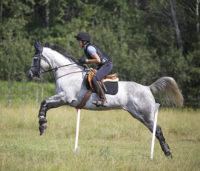
Much like humans, equine athletes performing at a high level can be at risk for certain conditions that cause poor performance. “Factors that make them athletes also predispose them to disease,” says Dr. Julia Montgomery, a specialist in large animal internal medicine at the Western College of Veterinary Medicine (WCVM). Horses have a very large heart with a low resting …
September 10th, 2015 Full story »
-
Regular dental checkups health investment
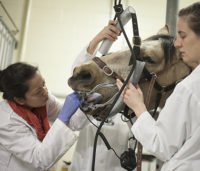
Everybody knows the importance of regular dental checkups when it comes to human health, so it should come as no surprise that horse health is just as dependent upon regular oral health checks. Dr. James Carmalt, a professor of equine surgery and a specialist in equine dentistry at the Western College of Veterinary Medicine (WCVM), recommends that horses receive routine …
August 03rd, 2015 Full story »

-
The foaling mare: preparation is key
If you ask anyone who has bred horses, they will tell you that it’s no easy feat. However, when it is done properly (and everything goes right), having an energetic and healthy foal is an exciting and rewarding experience. Dr. Stephen Manning is a board-certified theriogenologist and an associate professor at the Western College of Veterinary Medicine (WCVM). Based on …
July 08th, 2015 Full story »